

Environmentally Responsible Care for Your Trees, Shrubs, and Ornamentals
At Emerald Tree & Shrub Care, we believe the best way to protect your landscape is through Integrated Pest Management (IPM). IPM programs are the most beneficial and environmentally friendly way to manage insects and diseases. By combining proactive monitoring with targeted treatments, we keep your trees, shrubs, and ornamental plantings healthy while minimizing the use of chemicals.
We also design custom IPM programs for orchards, ensuring both beauty and productivity in a safe, sustainable way.
Benefits of Our Plant Healthcare & IPM Programs
Environmentally Friendly
We use the most eco-responsible products available, focusing on treatments that are safe for families, pets, and pollinators.
Proactive Protection
Regular site visits and monitoring allow us to detect insect and disease pressures early—before they cause serious damage.
Targeted Treatments
Instead of blanket spraying, we apply materials only when and where they are needed, reducing unnecessary inputs.
Healthier Plants
By controlling pests and diseases in NY & CT, your trees and shrubs maintain stronger growth, fuller foliage, and improved resistance to stress.
Customized Programs
Each property and plant species has unique needs. Our arborists design programs tailored to your landscape, whether it’s ornamental gardens or working orchards.
Long-Term Savings
Preventive care reduces costly removals, replacements, and emergency treatments by addressing issues before they escalate.
Sustainability
Healthy plants contribute to cleaner air, cooler landscapes, and improved property value—all while minimizing environmental impact.
Reach out today to rid your property of unwanted diseases and pests in New York & Conneticut!
Schedule your free consultation
Emerald Can Rid Your Property of the Following Pests and More
Spotted Lanternfly
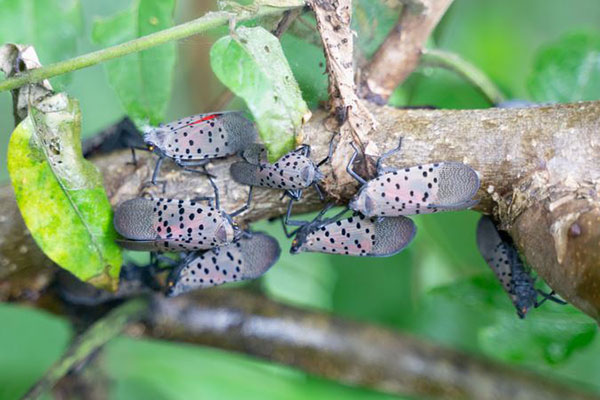
The Spotted Lanternfly is a pest that feeds on more than 70 woody plant species, including popular plantings found in our area: blueberries, lilac, birch, maple, poplar, and more. Adult species prefer to feed on specific plantings, such as apple, stone fruit, grapes, black walnut, and more.
Symptoms of Spotted Lanternfly
- Wilting foliage
- Branch dieback
- Honeydew (clear sticky substance) at the base of the tree
- Oozing sap from trunk
- Sooty mold at the base of the tree
- Increased bee, ant, and wasp activity due to exposed sap and honeydew
- Swarming, which interferes with people’s ability to enjoy the outdoors
The Dangers of Spotted Lanternfly
- These pests have a very powerful ability to reproduce in mass quantities. Females lay between 30-50 eggs at a time, in what looks like a disgusting gray goop. With an average of two hatches per season, that means each female is creating roughly 100 new spotted lantern flies each year!
- They are not picky about their host. Not only can they hop around easily, they pose a threat to a variety of different industries.
- They have no known predators. Birds do not seem to like to eat them and no other predator has been identified, keeping their population relatively stable.
Treatment Options
At Emerald, we do everything within our power to protect and save your valuable plantings. Our goal is to avoid removing trees and instead, work together with our neighbors to help remove Spotted Lanternflies and their egg masses. Through the help of our Plant Health Care Program, our expert Arborists routinely inspect properties and implement application techniques, such as topical or systemic applications. To prevent future problems, we develop a custom plan to prevent and fight these pests from wreaking havoc on trees and properties.
Already Infested?
If your property is already infested, don’t worry – our experienced team is equipped to tackle the problem. We offer comprehensive treatment options to effectively eradicate spotted lanternflies. Our treatment methods include:
Our Services in NY & CT
Spotted Lanternfly Prevention: Our proactive approach focuses on preventing spotted lanternfly infestations before they occur. We assess your property for potential risks and implement strategies to deter these pests from invading your trees and shrubs. Our prevention methods include:
Inspection
Inspection and Monitoring: Our trained professionals conduct thorough inspections to identify any signs of spotted lanternfly activity. Regular monitoring helps us diagnose and treat tree diseases and catch infestations in their early stages.
Systemic Insecticides: We utilize targeted systemic insecticides that are absorbed by the tree’s vascular system, making it toxic to spotted lanternflies when they feed on the sap. This approach provides long-lasting protection.
Spotted Lanternfly Treatment
If your property is already infested, don’t worry – our experienced team is equipped to tackle the problem. We offer comprehensive treatment options to effectively eradicate spotted lanternflies. Our treatment methods include:
Insecticide Spraying
We use proven insecticides applied directly to affected trees and shrubs, targeting spotted lanternfly nymphs and adults. Our trained technicians ensure safe and precise application.
Tree and Shrub Health Care
Maintaining the overall health of your plants is crucial in combating spotted lanternfly infestations. Our team provides tree and shrub care services, including fertilization, pruning, and disease management, to enhance their natural defense mechanisms.
Expertise
Our team consists of certified arborists and experienced tree disease specialists in NY & CT, professionals who have extensive knowledge of spotted lanternflies and their control methods.
Emerald Ash Borer
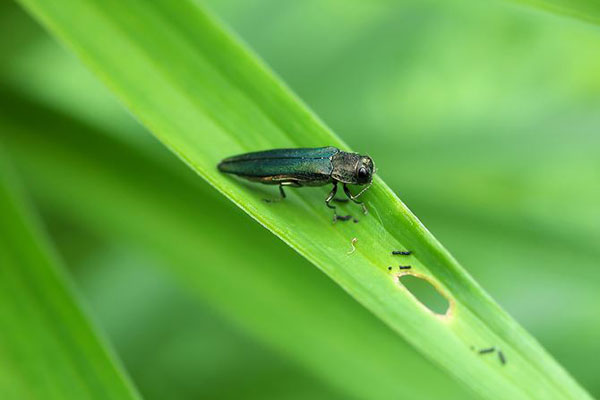
Since its discovery in the US in 2002, this insect has killed over 40 million Ash Trees in North America. As of 2016, the Emerald Ash Borer has been confirmed in 24 states, including New York, Connecticut, and New Jersey. It is close to impossible to detect an infestation unless the pest has inhabited a tree for a few years, and that is why our team of Arborists is knowledgeable about the symptoms and treatments of this invasive pest.
Symptoms of Emerald Ash Borer
- Ash canopy dieback
- Splitting bark
- D-shaped holes
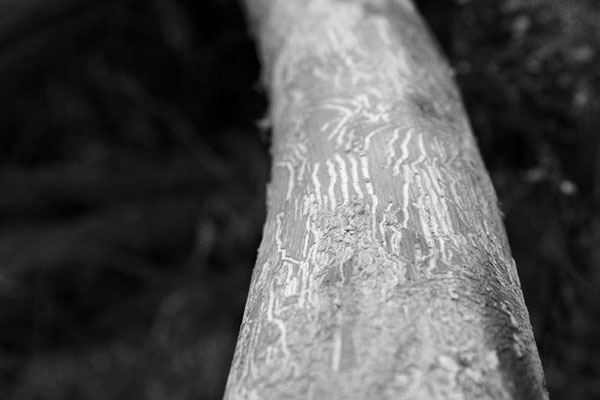
- S-shaped galleries
- Woodpecker activity
Treatment Options
Our Arborists have years of experience identifying and treating these pests. At Emerald, we have developed a comprehensive treatment plan to protect your Ash Trees from this highly invasive bark beetle. The first step is to inject your Ash Trees in Late Spring with a preventative treatment called Tree-Age. This treatment will protect your Ash Tree for up to two full years. As an added precaution, we recommend a merit soil drench once during peak growing season. The merit treatment lasts for one year and is therefore prescribed annually.
Dutch Elm Disease
Dutch Elm Disease is an extremely dangerous and often fatal disease of trees if left untreated. This disease is considered one of the most destructive shade tree diseases in North America. Once it affects an Elm tree, neighboring trees are soon to be affected. The disease can spread in two ways:
- By the Elm Bark Beetle. Adult beetles tunnel into bark to lay eggs. Once the eggs hatch, larvae begin to feed on sapwood, eventually maturing and leaving the fungus-infested tree. These adults then carry the fungus, introducing the disease to neighboring trees.
- Through interconnected root systems. Neighboring trees can spread from infected trees to uninfected trees through their connected root systems.
Symptoms of Dutch Elm Disease
- Premature leaf drop
- Wilting, yellowing, and browning of leaves
- Branch death
- Streaking in sapwood (can be detected by an Arborist)
Treatment Options
Although the American Elm Tree is very susceptible to this disease, there are many preventative treatment options you can take along with an expert. At Emerald, a tree disease management company in NY & CT, our Arborists and highly trained technicians can prune, protect, and apply safe treatments to ensure your trees are protected. Our professionals work with our clients every season, ensuring their landscapes are fortified against such threats, through the help of our Plant Health Care Program coupled with expert care.
Oak Wilt
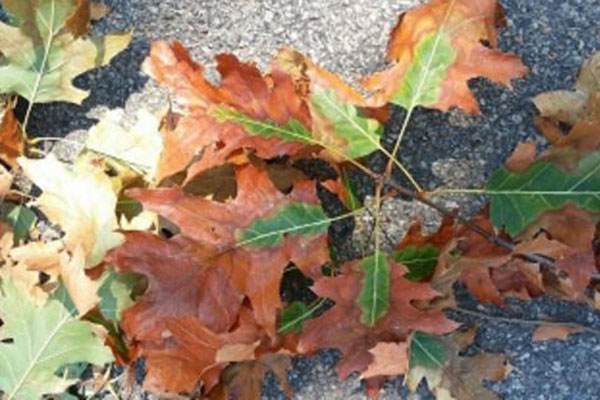
Oak wilt is a fungal disease specific to Oak Trees. It is fatal to all species of the red oak group (pointy leaf lobes) and less detrimental to those in the white oak family (rounded leaf lobes). Oak wilt is passed from one tree to another through interconnected root systems, or by sap-sucking insects that are attracted to freshly cut branches and limbs. This disease spreads at a very rapid pace, often harming mature Oak Trees in a number of weeks.
Symptoms of Oak Wilt
- Branch dieback starting at the top of a tree’s canopy that moves downward
- Brown coloration of leaves that starts on the outer edge of leaves and progresses towards the center
- Wilting leaves in the spring and summer months
- Fungal spores that develop under the bark of infected trees
Treatment Options
With Oak Wilt being such a fast-acting disease, we ask our clients and neighbors to call us immediately if they suspect a problem. There is no cure for Oak Wilt; however, an Arborist can stop this disease from spreading through proper treatments, such as injections and seasonal pruning.
Boxwood Blight
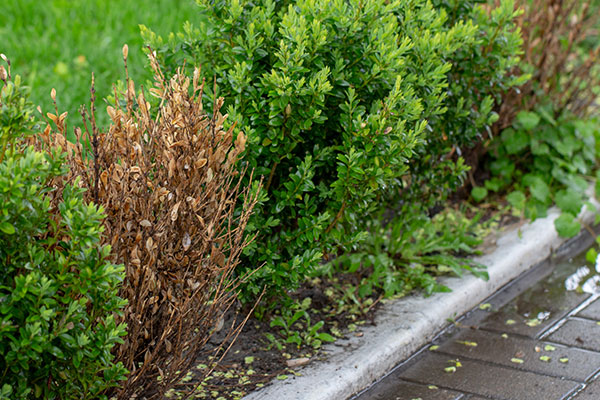
Boxwood Blight is a fungal disease caused by Cylindricladium Pseduonaviculatum. This fungus causes discoloration and lesions on the leaves of shrubs, and abrasions will soon appear on stems. If left untreated, shrub leaves will drop, causing stress to plantings and eventually death.
Symptoms of Boxwood Blight
- Rapid defoliation on leaves (within a matter of weeks)
- Black spots on leaves
- Discoloration on leaves
- Streaks and discoloration on branches
To combat diseases in shrubs, Emerald’s ISA-certified Arborists conduct multiple property inspections of your landscapes each year. During these evaluations, our team determines the overall health of landscapes, diagnoses any disease or problems, and then implements safe, custom-made treatments.
Beech Leaf Disease
Beech Leaf Disease is here. Protect your trees today!
Beech Leaf Disease (BLD) affects and kills both native and ornamental beech tree species.
It is associated with a nematode, Litylenchus crenatae mccannii.
The disease was first discovered in Ohio in 2012. Neighboring infections currently exist in Ohio, Pennsylvania, New Jersey, Connecticut, Massachusetts, Rhode Island, and Ontario, Canada.
- Beech Leaf Disease is here
- Is spreading FAST!
- It can kill your trees
- It’s a fungus
- It affects native and ornamental trees
How To Identify Beech Leaf Disease?
- Striping – bands of thickened, dark green tissue between the leaf veins.
- Distorted, puckered, or curled leaves.
- Leaf symptoms that are visible from leaf out until fall are best seen by looking up into the canopy.
- Some branches may be affected while others are not.
- Reduced leaf and bud production and possible leaf loss as the disease progresses.