

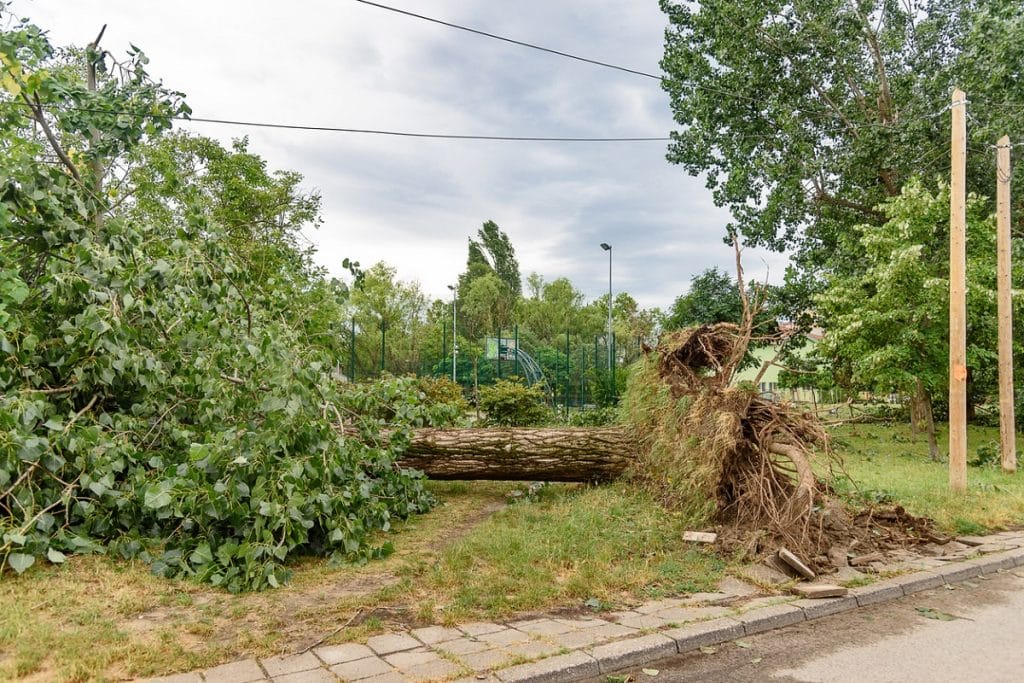
You have had a storm come through your property and are left to question the safety of your trees. Perhaps a tree that was in fine shape a month ago is not looking right. How can one be sure it is a serious matter lurking below ground and not just some superficial damage?
For the homeowner or property manager in Westchester County, NY and Fairfield County, CT, Emerald Tree & Shrub Care Company has been putting such questions to rest since 1996. Should you have any misgivings that a tree on your grounds has been put at risk by the elements, an arborist from our company is available for an evaluation at (914) 342-7418.
It is not only branches that storms break. The root system is out of sight but can be as easily harmed by high winds and heavy rain on waterlogged soil. A weakening of the roots puts the whole tree in the position of being a hazard, though there are telltale signs if one knows where to look.
Why You May Overlook Root Damage
A tree’s roots are what hold it in place and provide for its survival. After a storm has done its work of tearing or loosening them, the tree will often present a deceptively healthy front. In time it may come down with scant warning after standing for weeks or months.
Subtle changes in the aftermath of a storm are therefore worth noting; they are small surface indicators of what is going on underneath.
What to Inspect For
Make a point of walking the property and giving each tree a good once over. Any of the following would point to a root system that has been compromised:
- An uncharacteristic lean to a tree, one that was straight until a hard wind
- Heaving, mounding or cracking of the soil at the base of the trunk
- Roots that were once under cover now torn or lifted up
- Openings in the soil about the trunk
- Some shifting of the trunk at the soil line with the wind
- Puddles or soggy earth in the root zone when the rain is done
Combine two or more of these and the risk is all the greater.
Symptoms That Take Time to Emerge
Not all damage is apparent in the immediate wake of a storm. Give the coming weeks a watch for:
- Wilting or browning of leaves, or their premature dropping, most often on one side of the canopy
- New growth in the spring that is sparse or undersized
- Branches that die back from the tips
- Conk, mushrooms or fungus making an appearance at the root zone or near the trunk
- A lack of vigor in the tree vis-a-vis others of its type in the vicinity
Such things are evidence the tree is having trouble with its uptake of water and nutrients, a direct result of storm injury to the roots.
The Case of the Leaning Tree
This is a red flag of the first order. When a tree has taken on a new lean and the soil at the base is heaved or cracked, you can assume a partial failure of the root plate. It does not take much notice for a tree in this condition to topple on a car, fence or home. Put people and pets at a distance and get an evaluation without delay.
Making the Call to a Professional
While some damage is easy to read, root damage is not. To determine if a tree is beyond recovery or a hazard to be removed requires the eye of a pro. Our ISA Board Certified Master Arborists will appraise the canopy, trunk and root zone and make the situation plain.
We have over a century of experience between us and the equipment to match. With a safety-first mentality we handle jobs for everyone from private estates and HOAs to corporate campuses in the Lower Hudson Valley and Southwestern Connecticut. We also give free estimates so there is no need to put off a decision.
There is no value in guessing if a tree is sound after a storm. Get in touch with Emerald Tree & Shrub Care Company at (914) 342-7418 for a professional hazard tree evaluation. We are on hand around the clock for emergency response to storm damage and other pressing hazards to ensure your property remains secure.